
Replacement of HVAC is normal as more than three million heating and cooling systems are replaced in the US annually. However, upgrading your HVAC in San Antonio does not have to break the bank and can even be cheaper if the timing is right, which can potentially save you a few thousand. Moreover, planned residential HVAC services in San Antonio TX can increase your HVAC system's lifespan by 20%, which means there’s a higher chance of your system running beyond its typical life of 15 years, squeezing a few more years before paying for another install.
So, when is the least expensive time of year to replace an HVAC in San Antonio, TX? This article analyzes the best value time of year to install a new residential HVAC system in San Antonio TX, and why timing is important.
The cheapest time of year to have your San Antonio HVAC system replaced affordably is in the spring and fall, also referred to as the shoulder seasons. These seasons have mild weather, so HVAC firms are not as busy as they are during the hottest summer and winter seasons.
In San Antonio, an HVAC system works for about 10 to 15 years before replacement for better energy savings with the new system. The cost of replacing an air conditioner depends upon the brand, the energy-efficiency rating, and the difficulty of the installation.
Smart homeowners know when you replace your system, it makes a big difference in your cheque. Plus, efficient maintenance after installation can cut costs of AC repair in San Antonio by as much as 12–18%, which can even pay for the plan itself in the long run.
Most common home size in San Antonio, TX is 1,950 to 2,000 sq ft, which means a 3-4 ton HVAC system would suffice and can cost $10,000 to $14,000 depending on the system type and brand.
System Type | Size (Ton) | Estimated Cost Range |
HVAC System (Furnace + AC) With Minimum Efficiency Rating | 2 Ton | $8,000 – $11,000 |
3 Ton | $9,000 – $12,000 | |
4 Ton | $11,000 – $14,000 | |
Heat Pump + Air Handler Combo (14.3 SEER Rating) | 2 Ton | $7,000 – $10,000 |
3 Ton | $9,000 – $12,000 | |
4 Ton | $10,000 – $13,000 |
Note: Please remember that these are just general industry HVAC estimates and don’t reflect actual costs because HVAC unit costs vary significantly based on the size of your property, type of system, and inflation among many things.
We can present several reasons to try to convince you why you should get HVAC replacement in San Antonio, Texas in Fall and Spring. However, it only makes sense to do so in these shoulder seasons because of these 3 key reasons:
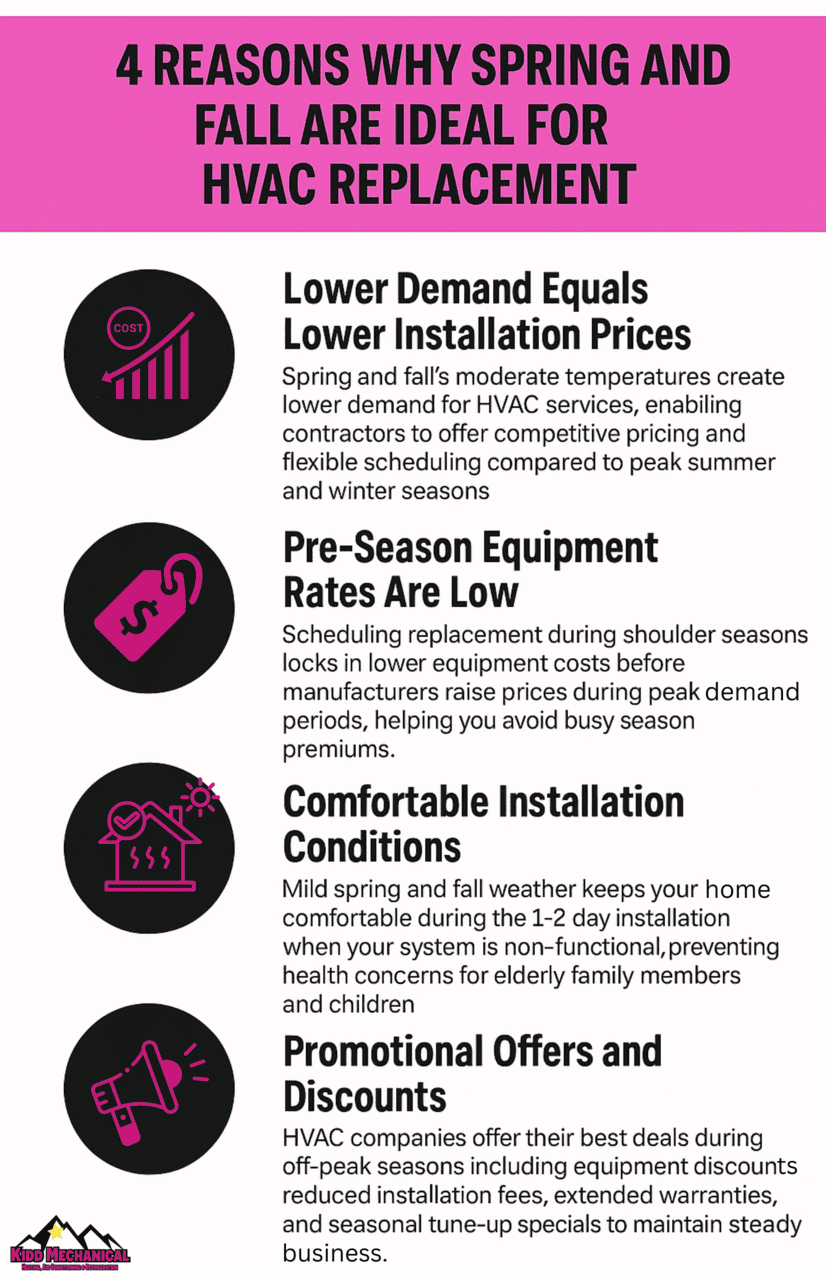
During San Antonio's hot summers and chilly winters, HVAC service providers have an influx of calls for maintenance and AC repair in San Antonio, which leads them to increase their prices as well as delay times.
During San Antonio's spring and fall, which experience moderate temperatures, they have a lower demand, which enables them to provide competitive pricing and favorable scheduling.
Locking in pre-season pricing saves you money because HVAC equipment costs often rise when peak summer or winter demand hits. Manufacturers and suppliers typically increase prices during these busy seasons due to higher volume and potential supply chain pressures.
If you schedule your replacement in spring or fall, you'll likely secure pricing before these seasonal hikes take effect. This strategic timing helps you avoid paying the "busy season premium" that comes with peak demand.
Milder spring and fall temperatures make your home comfortable during installation, which means you and your family can easily spend the time without worrying about extreme heat or cold. This is because your air conditioner will be non-functional during the replacement, avoiding inconvenience and possible health concerns, especially if you have elderly and children in your home.
Promotions are frequently introduced by residential HVAC services in San Antonio during off-seasons to boost business. These may involve discounting equipment, installation, or extended warranties. For example, there might be a few seasonal tune-up specials provided by manufacturers and installers as a bonus with HVAC replacement that can save you a few hundred bucks on maintenance for the next few tune-ups.
Let’s see what are the key players behind the increase and decrease in cost of HVAC replacement so you can better understand what causes the numbers to go up and down and make better decisions.
The cost is immediately influenced by the HVAC system's size, which would measure in tons. A 2-ton model would cost an estimated $8,000-$11,000, while a 3 to 4 ton model would cost $11,000-$14,000. Sizing is important, as an under-sized model will fail to cool your house, while an oversized model will short-cycle frequently, resulting in decreased efficiency and lifespan.
More efficient systems are reflected in higher SEER ratings, though they do have higher initial costs. Still, they translate into long-term cost savings, which makes them an investment well worth making in San Antonio's climate.
For instance, a 16-20 SEER system can save you 37.5% to up to 50% on cooling costs compared to a 10-14 SEER unit, making it an excellent investment for San Antonio's hot climate.
To estimate annual savings, use this formula:
(System Capacity in Btuh) × (Annual Runtime Hours) × (Your kWh Rate) ÷ (SEER × 1000).
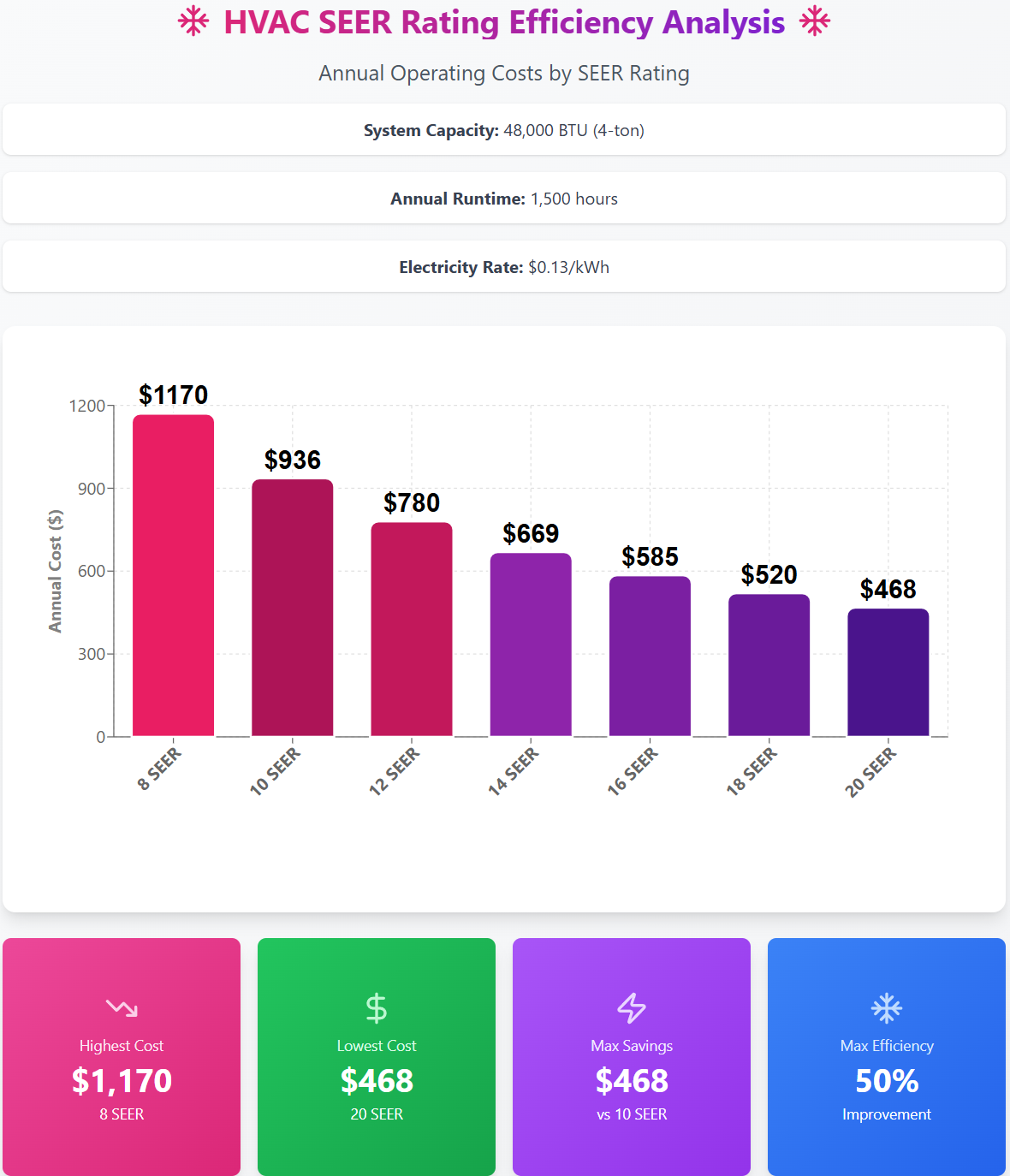
For example, a 48,000 Btuh unit running 1,500 hours yearly at $0.13/kWh (average for San Antonio) costs $936 annually at 10 SEER vs. $585 at 16 SEER—saving $351/year. Here’s detailed comparison for a 4-ton HVAC system’s annual operating cost at different SEER ratings:
Key Assumptions:
SEER Rating | Annual Cost | Savings vs. 10 SEER | Efficiency Gain vs. 10 SEER |
8 SEER* | $1,170 | - | - |
10 SEER | $936 | Baseline | 0% |
12 SEER | $780 | $156 | 16.7% |
14 SEER | $669 | $267 | 28.5% |
16 SEER | $585 | $351 | 37.5% |
18 SEER | $520 | $416 | 44.4% |
20 SEER | $468 | $468 | 50.0% |
Each 2-SEER increase reduces annual operating costs by 12-17%. Upgrading from 10 SEER to 16 SEER saves 37.5% ($351/year), while 20 SEER saves 50% ($468/year)—equivalent to 2-4 months of summer cooling expenses.
A qualified technician can refine this calculation using local climate data and your usage patterns, proving the investment pays dividends in extreme heat.
If your current ductwork is obsolete or not compatible with the new system, replacement or alteration might be required.
Modifications usually cost an additional $2,000 to $3,000 for each ton of heating and air conditioning capacity.
High-end models with features such as variable-speed motors or improved humidity control are higher in initial cost but may provide improved performance and durability.
Brand and model selections can play an important part in both the investment cost and future satisfaction with your heating and air conditioner.
The labor costs can be influenced by the relative simplicity or difficulty of the HVAC installation. Some installations may require additional parts, such as new thermostats or zone systems, which can raise the cost.
For example, the cost can increase with an especially difficult installation location, such as an attic, basement, or closet.
Adhering to local building codes and acquiring required permits can increase the total expense of HVAC maintenance in San Antonio.
Having your installation comply with all regulatory requirements helps prevent costly fines and promotes the safety of your systems.
Replacing your San Antonio HVAC doesn't have to cost an arm and a leg when you plan and time your replacement perfectly. Getting an installation in the spring or fall can help you benefit from the reduced demand, tech availability, good weather, and special deals, all coming together to translate into decent savings.
On top of this, knowing the factors that affect the cost of an HVAC, including the size, energy efficiency, and need for ductwork, can help you make an informed choice regarding residential HVAC services in San Antonio. So, ready to replace your HVAC system? Contact us today, and our team will provide customized packages to meet your specific needs, ensuring comfort and savings for years to come!